A Jordanian client showed us forty Arabic pages, professionally translated from their English site, published over two years. Combined organic traffic: under 200 visits a month. The translation was accurate. That was precisely the problem.
Arabic content that ranks is not English content in Arabic. It answers a different question, in a different order, with different evidence.
Arabic content answers a different question
An English page about accounting software in the region tends to answer "which platform is best". The equivalent Arabic query in Jordan is far more often about compliance: does it handle JoFotara, does it produce a proper Arabic invoice, does it satisfy the Income and Sales Tax Department.
Translating the English page gives you a beautifully written answer to a question your Arabic reader did not ask. It will rank for nothing, because nothing they type matches what you wrote.
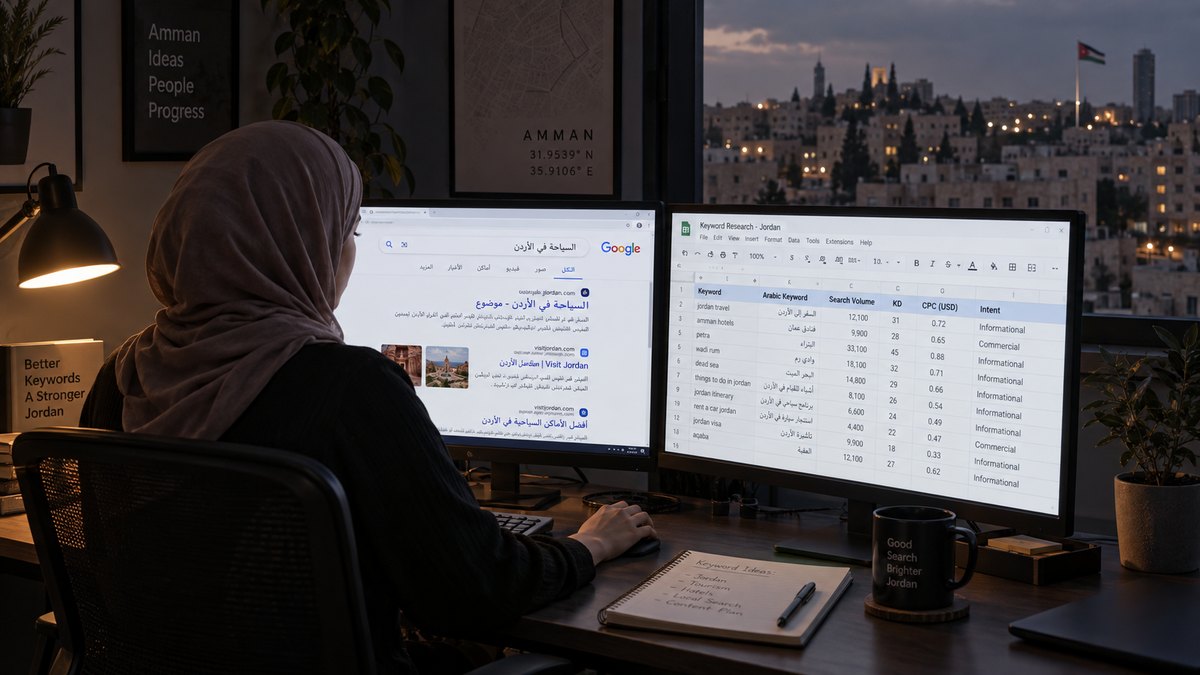
Before writing anything in Arabic, search your topic in Arabic and read the top five results properly. Note what they cover that your English page does not. That gap is your brief.
The structure is different
English business writing front-loads the conclusion. Arabic expository writing more often builds context first, then arrives at the point. Neither is better, but a reader who expects one and receives the other leaves early — and dwell time is a signal.
In practice this means the Arabic version of a page can carry a slightly longer opening that establishes the situation before the recommendation appears. Not padding: orientation.
Choose the register on purpose
Three registers coexist in Jordanian reading, and mixing them carelessly is the fastest way to sound machine-generated.
- Modern Standard Arabic for anything official, technical, financial or legal. This is the default for business writing and what most searches in those fields use.
- Lightly colloquial for consumer topics, where formal Arabic reads as stiff. Still written, but closer to how people speak.
- Technical terms in English where the Arabic equivalent is unfamiliar. Nobody in a Jordanian development team says حوسبة سحابية in conversation; they say cloud. Write the English term, then gloss it in Arabic once.
Pick one register per page and hold it. The most common failure we see is formal Arabic with sudden colloquial sentences, which reads as two people wrote it.
Local detail is your entire advantage
Arabic search results in Jordan are dominated by Egyptian and Gulf sites with far larger domains. You will not outrank them on authority. You outrank them on specificity.
An Egyptian article about opening an online store cannot mention that most Jordanian customers pay cash on delivery, that Amman postal addressing makes delivery instructions matter more than the address itself, or what a payment gateway actually charges in JOD. Every one of those details is a query you can win and they cannot.
Specificity to include wherever it is true:
- Prices in Jordanian dinars, with a date.
- Named local systems and regulators — JoFotara, the Income and Sales Tax Department, the Companies Control Department.
- Districts of Amman, not just "Amman".
- The Sunday-to-Thursday working week where it affects timelines.
- Real constraints of the local market, including the awkward ones.
Write the Arabic first, sometimes
For any topic where Arabic is the primary search language, write that version first and let the English follow. Reversing the usual order changes the result: the Arabic page becomes the original rather than the derivative, and it shows.
The English version can then be adapted rather than translated — same subject, restructured for a reader arriving with a different question.
What to do with forty translated pages
Do not delete them. Rewriting Arabic content is cheaper than starting over. Take the ten with the most commercial value and rewrite those properly, starting from Arabic search results rather than the English text. Leave the rest.
The client above did exactly that. Ten rewritten pages produced more organic traffic within a quarter than the forty translated ones had in two years. The other thirty were left untouched and cost nothing to keep.
A test before you publish
Read the Arabic draft aloud to a colleague who has not seen the English. If they ask what a sentence means, or if a phrase makes them pause, it is translated prose rather than Arabic prose. Fix it before publishing, because search engines increasingly measure the same hesitation in how readers behave on the page.