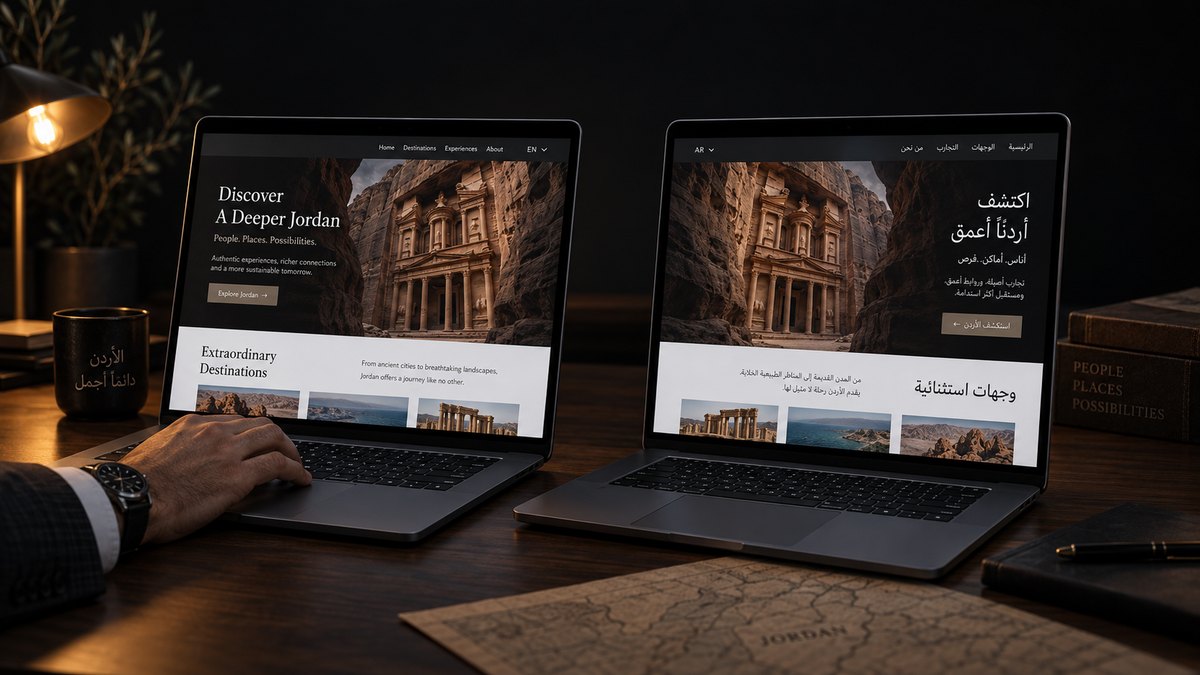
A Jordanian company we audited last year had two full versions of its site, Arabic and English, both well written. Arabic pages received 4% of organic traffic. The content was not the problem. Google simply did not know the two versions were the same pages in different languages.
Bilingual site structure is where most Arabic-English projects in Jordan lose their organic ceiling, and the errors are almost always structural rather than editorial.
Pick a URL pattern and never change it
Three patterns work. What matters is choosing one deliberately.
Subdirectories — example.jo/ar/ and example.jo/en/
This is what we recommend for almost every Jordanian business. Both languages inherit the domain's authority, one SSL certificate covers everything, and a link earned by an Arabic article strengthens the English side too.
Subdomains — ar.example.jo
Google treats subdomains as related but somewhat separate. Authority is shared less generously. Choose this only when the two sites are genuinely run by different teams with different content.
Separate domains — example.jo and example.com
Two sites, two authority profiles, twice the work. Occasionally justified for genuinely separate markets. Almost never justified for one company serving Jordan in two languages.
The hreflang rules that actually matter
Hreflang tells Google that two URLs are the same content in different languages. It does not affect ranking directly; it decides which version is shown to whom. Get it wrong and your Arabic page competes against your English page for the same query.
Every page must reference itself
This is the most common error. The Arabic page must list both the Arabic and English URLs, including its own. A page that names only its counterpart is ignored.
<link rel="alternate" hreflang="en" href="https://example.jo/en/services/">
<link rel="alternate" hreflang="ar" href="https://example.jo/ar/services/">
<link rel="alternate" hreflang="x-default" href="https://example.jo/en/services/">
The references must be reciprocal
If the Arabic page points at the English one, the English page must point back. Google discards one-directional declarations entirely — not partially, entirely.
Use absolute URLs
Relative paths in hreflang are ignored. Include the protocol and domain every time.
Include x-default
This tells Google what to serve someone whose language you have not declared — a French speaker in Amman, for instance. For most Jordanian businesses, English is the sensible default.
Match the language code to the page
Use ar unless you genuinely have separate Levantine and Gulf content. ar-JO narrows your reach to searchers Google identifies as Jordanian, which is rarely what you want when Jordanian companies sell across the region.
The canonical trap
We see this in perhaps a third of bilingual audits. Someone sets the canonical URL of the Arabic page to the English page, reasoning that English is the "main" version.
That instruction tells Google the Arabic page is a duplicate that should not be indexed at all. The hreflang tags then contradict the canonical, and Google resolves the conflict by trusting the canonical. The entire Arabic side disappears from search.
Each language version must canonicalise to itself. The Arabic page's canonical is the Arabic URL. Always.
What else has to switch with the language
Bilingual site structure is not only URLs. These must change too, and often do not.
<html lang="ar" dir="rtl">— both attributes, on every Arabic page.- Meta title and description, written in Arabic rather than translated word for word.
- Open Graph locale —
ar_JOorar_AR— so shared links preview correctly. - Structured data
inLanguage, and any names inside it. - Image alt text. Arabic alt text is how you rank in Arabic image search.
How to check yours in ten minutes
- Open an Arabic page and view source. Confirm three hreflang lines, all absolute, including self-reference.
- Confirm the canonical points at the Arabic URL, not the English one.
- Open the English counterpart and confirm the same three lines are present there.
- Check
<html>carries bothlanganddir. - In Search Console, split performance by page and compare the two language directories. If Arabic is under 15% of impressions in a market that searches mostly in Arabic, something structural is wrong.
What fixing it is worth
For the company above, correcting the canonicals and adding self-referencing hreflang took a developer two days. Arabic impressions rose steadily over the following quarter and settled at roughly nine times the previous level. No new content was written.
That is the nature of structural SEO problems: the traffic was always available, and the site was simply preventing Google from delivering it.