A client told us their organic traffic had grown 40% in six months and they were pleased. Split by language, English had grown 62% and Arabic had fallen 9%. In a market that searches mostly in Arabic, they had been celebrating a decline.
Measuring SEO on a bilingual site is mostly a segmentation problem. The aggregate number is not merely less useful than the split — it is actively misleading, because the larger language masks the smaller one.
Segment by language before anything else
If your site uses /ar/ and /en/ directories, this takes ten minutes and should have been done on launch day.
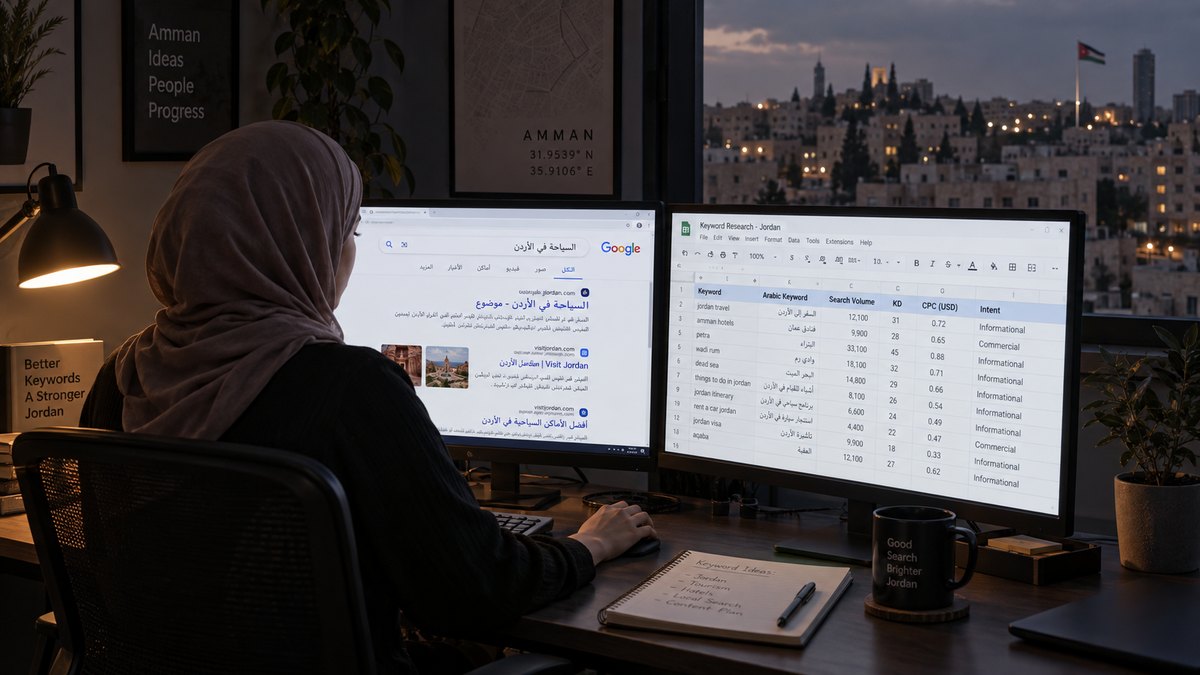
- Search Console: create two filtered views by page path — one containing
/ar/, one containing/en/. Compare impressions, clicks and average position separately from then on. - Analytics: add a segment or a filter on landing page path, so every report can be viewed per language.
- Reporting: never show a combined organic figure without the split beside it.
Do this once and every later question becomes answerable. Skip it and you will spend a year optimising blind.
Measuring SEO: the four numbers worth watching
1. Impressions by language
The earliest signal, and the least vain. Impressions move weeks before clicks do, so a rising Arabic impression count tells you a change is working before traffic confirms it.
2. Average position on the queries you chose
Not average position overall, which drifts with every long-tail query you accidentally rank for. Pick fifteen to twenty terms per language that you deliberately targeted, and track only those.
3. Click-through rate per language
This is where bilingual sites most often leak. A page can rank third in Arabic and still be ignored because its meta description is English, or is a literal translation that reads awkwardly. If Arabic CTR is materially below English CTR at the same position, the problem is your snippet, not your ranking.
4. Enquiries by landing-page language
The only number that pays anyone. Tag your contact form with the language of the page the visitor arrived on. Without this you cannot tell whether Arabic traffic converts, and that single fact decides where the next quarter's effort goes.
What to stop reporting
- Keyword rankings on their own. Position varies by device, location and personalisation. A rank report without impressions beside it describes a moment, not a trend.
- Total backlinks. Ten relevant Jordanian links beat four hundred directory entries, and a raw count cannot tell the difference.
- Domain authority scores. Third-party estimates, not Google metrics. Useful for rough comparison, useless as a target.
- Bounce rate on informational pages. Someone who reads your article fully and leaves satisfied is a success that this metric records as a failure.
A reporting rhythm for measuring SEO
Monthly is too frequent for SEO and quarterly is too slow to correct a mistake. We use both, at different depths.
- Monthly, fifteen minutes: impressions and clicks per language, top five gainers, top five losers. Look for anything broken, not for progress.
- Quarterly, properly: tracked-term positions, CTR by language, enquiries by landing page, and a decision about what to write next.
Two Jordan-specific things to check
Location filtering
Filter Search Console by country. A Jordanian business often finds a meaningful share of Arabic impressions coming from Saudi Arabia or Egypt. That is not necessarily bad — but if you cannot serve those markets, exclude them before judging whether Arabic is performing.
Seasonality that is not in the textbooks
Ramadan changes search behaviour and volume in ways that have nothing to do with your SEO, and the shift differs by sector. Compare Ramadan to Ramadan, not to the previous month, or you will read a normal seasonal dip as a penalty.
A three-line report
Most SEO reports are too long to be read. Ours fits in three lines:
Arabic: impressions X, clicks Y, enquiries Z.
English: impressions X, clicks Y, enquiries Z.
This quarter we are writing about A, because of B.
Measuring SEO well is not about collecting more data. It is about keeping the two languages apart, so you can see which one needs the work.